

Professor
Christie Shin
- School of Art and Design
- Creative Technology & Design
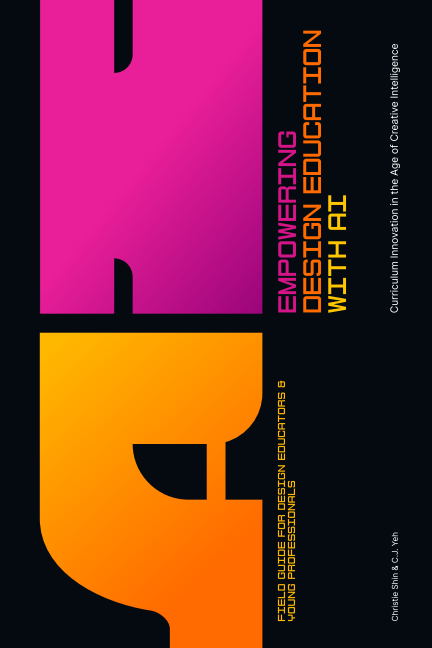
Empowering Design Education with AI
Curriculum Innovation in the Age of Creative Intelligence
Co-Author: C.J. Yeh
Design education is falling behind. Curriculum cycles take years. The creative industry moves in months. Students are graduating into a workforce that has already moved on.
Empowering Design Education with AI is the first firsthand account of systematically integrating AI into a major American design curriculum. Christie Shin and C.J. Yeh, Professors of Creative Technology and Design at FIT, take you inside the work: building the AI-Assisted Design minor, launching new courses, forming industry partnerships, and teaching students to lead with Creative Intelligence rather than compete with machines.
The Five Pillars of Creative Intelligence, pioneered by Shin and Yeh, give educators an adaptable framework: Problem Framing, Research-Driven Innovation, Systems Thinking, Domain Knowledge, and Holistic Creative Intelligence. Interviews with industry thought leaders and evidence from real student work ground every chapter.
Written for design educators building the next curriculum, and for designers and students building the next chapter of their careers.
How did you first come up with the idea for this work?
The idea came from a gap I saw every day. The creative industry was moving faster with AI than any curriculum committee could convene, and students were graduating into a creative workforce that had already moved on. C.J. Yeh and I had spent years building Creative Technology & Design at FIT, a program designed to close that gap, and by 2023 we were teaching AI-Assisted Design courses and developing a new minor. That work became my sabbatical topic for Spring 2026, and that same year I was selected as a 2026 Google Higher Ed Faculty AI Fellow. My R&D grew extensive, tested through field experience in our own design studio, Cynda Media Lab (CML), and with AI startups. I began documenting it, then broadened the focus to the creative industry, including interviews with ten creative industry leaders. At the same time, we were getting overwhelming requests from educators, designers, students, and many more to share our approach to AI in the age of Creative Intelligence. They needed the full story and a framework they could actually use, so C.J. and I expanded it into this book.
What was your research process like?
We worked in three layers. First, our own curriculum: the courses, the Five Pillars framework, and the partnerships and events we’d built, documented from the inside. Second, our students. We tracked their outcomes, and the results spoke for themselves. In 2026, they won 21 One Club Young Ones awards, 8 of them in newly created AI categories, including an ADC Gold Cube in the AI: Process category. Our program ranked third worldwide in the Young Ones college rankings. And 6 of our 16 seniors were hired before graduation, more than a third of the class. Third, the creative industry. We interviewed ten leaders, from Notion and Google DeepMind to Meta, IBM, and FLORA, and asked each of them some version of the same five questions: what’s changing, what they’re hiring for, what they wish design schools were teaching, where the human contribution still lives, and what gives them hope. Published sources and industry research filled in the bigger picture.
How long did you work on this before it was published?
About three years, leading to publication in August 2026. The curriculum work behind it reflects more than twenty years of building programs together with C.J. Yeh.
Does this work relate to your role at FIT? If so, how?
Directly. I’m a Professor of Creative Technology & Design and serve as Curriculum Committee Chair and Co-Coordinator of the Creative Technology & Design subject area. The book documents the AI-Assisted Design Minor and the courses C.J. and I developed, including CT380 AI-Assisted Design, CT390 Rapid Prototyping with AI, CT400 Digital Product Design with AI, and CT460 Brand Experience Design Portfolio. FIT is the setting for the work, and our students’ outcomes are the evidence behind it.
What was your biggest challenge? What was most rewarding?
The biggest challenge was writing about a field that changes every day. AI tools shifted even while we were writing, so we kept the book grounded in thinking, domain knowledge, and creative process rather than specific tools, a core principle of design education. We emphasize AI-in-the-loop: humans lead, not AI.
The most rewarding part was hearing industry leaders describe, in their own words, the same approach and values our curriculum was built to teach, and seeing our students’ work recognized on a global stage. It confirmed that the program is preparing students for the creative workforce as it actually is.
Is there other information we should know?
The book is published by Cynda Media Lab (CML), our design studio, whose publishing division specializes in timely subjects for design education and the creative industry, fields that have to keep adapting to change. Another CML publication we’re proud of is the Remote Learning Playbook, released during the pandemic. Beyond the book, my community involvement includes serving as a 2026 Google Higher Ed Faculty AI Fellow (Inaugural Cohort) and a Founding Member of the Figma Educator Advisory Board. I also received the SUNY Chancellor’s Award for Excellence in Scholarship and Creative Activities (2023–2024).
Have you published any other books or have any upcoming publications?
- Remote Learning Playbook (SC·REL™), co-author with C.J. Yeh, September 2021. ISBN 978-0-9883995-3-2
- Design Innovation and Education, co-author with C.J. Yeh, September 2018. ISBN 978-0-9883995-9-4
- Digital Media and Cognitive Learning in Preschool Education, author, May 2014. ISBN 978-0-9883995-1-8
- Professor at FIT since 2008
- Book published in August 2026