

Professor
C.J. Yeh
- School of Art and Design
- Creative Technology & Design
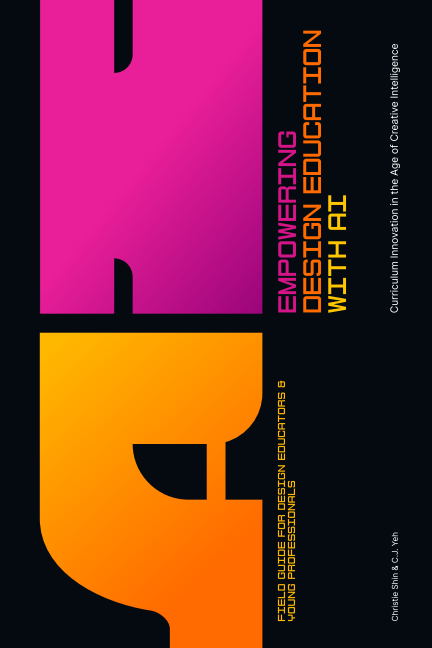
Empowering Design Education with AI
Curriculum Innovation in the Age of Creative Intelligence
Co-Author: Christie Shin
Design education is falling behind. Curriculum cycles take years. The creative industry moves in months. Students are graduating into a workforce that has already moved on.
Empowering Design Education with AI is the first firsthand account of systematically integrating AI into a major American design curriculum. Christie Shin and C.J. Yeh, Professors of Creative Technology and Design at FIT, take you inside the work: building the AI-Assisted Design minor, launching new courses, forming industry partnerships, and teaching students to lead with Creative Intelligence rather than compete with machines.
The Five Pillars of Creative Intelligence, pioneered by Shin and Yeh, give educators an adaptable framework: Problem Framing, Research-Driven Innovation, Systems Thinking, Domain Knowledge, and Holistic Creative Intelligence. Interviews with industry thought leaders and evidence from real student work ground every chapter.
Written for design educators building the next curriculum, and for designers and students building the next chapter of their careers.
How did you first come up with the idea for this work?
I started researching and experimenting with AI in my own creative work around 2020, and I began developing AI-focused curriculum with Prof. Shin in late 2022. Our first new course, CT380 AI-Assisted Design, was approved in 2023. Since then, we have continued our research and curriculum development while collecting data through student surveys and interviews.
The idea for the book actually came from Prof. Shin. As part of her Google Higher Education AI Faculty Fellowship, she suggested that we bring together our experiences, findings, and case studies and share what we have learned with educators around the world.
What was your research process like?
For a fast-moving subject like AI, our research process has been continuous and highly iterative. Much of our research happens online, where we follow emerging technologies, new tools, industry developments, academic research, and the rapidly evolving conversations surrounding AI. We also speak directly with subject-matter experts who are at the forefront of developing and applying AI technologies.
Equally important, our classroom became a research environment. We continuously tested new tools and methodologies with our students, observed how they affected the creative process, and gathered feedback through surveys, interviews, and classroom discussions. This allowed us to connect technological developments with real-world teaching and learning experiences.
Because AI changes so quickly, we realized that our goal could not simply be to document a particular set of tools. Instead, our research focused on identifying broader principles, methodologies, and frameworks that could remain relevant even as the technology continues to evolve.
How long did you work on this before it was published?
On my end, the book represents about four years of research, experimentation, and curriculum development.
Does this work relate to your role at FIT? If so, how?
Absolutely. This work is deeply connected to our roles at FIT. Much of the research, experimentation, and curriculum development behind the book grew directly out of our teaching and our work developing new courses within Creative Technology & Design.
What was your biggest challenge? What was most rewarding?
The biggest challenge was the speed at which AI technology was, and still is, evolving. Tools, capabilities, and industry practices can change dramatically within months or even weeks. We quickly realized that we could not build a curriculum around specific tools. Instead, we needed to develop principles and methodologies that would help students adapt to continuous change while strengthening the human skills that remain essential to creative practice.
The most rewarding part has been seeing the impact on our students. We are teaching during a particularly challenging time for recent graduates entering the creative industry, yet we are seeing our graduates secure jobs and begin their careers successfully. Some have been hired specifically because of their ability to combine strong design fundamentals with emerging AI skills. Seeing students turn what they learned at FIT into real career opportunities is perhaps the most meaningful validation of our work.
Is there other information we should know?
Our company, Cynda Media Lab (CML), has a publishing unit that specializes in timely subjects, particularly where design, technology, and education intersect. During the pandemic, we published Remote Learning Playbook: Synchronous and Collaborative Experiential Learning (SC·REL) to share the teaching and learning framework we developed for remote education, along with practical strategies that other educators could immediately apply in their classrooms.
Empowering Design Education with AI follows a similar philosophy. When education is facing significant change, we believe it is important for educators to share what we are learning rather than wait until everything is fully settled. Both books grew out of real teaching experiences and were created to share practical frameworks, methodologies, and lessons that can help other educators navigate rapidly changing environments.
Have you published any other books or have any upcoming publications?
This is my 11th book. My earlier publications include books published by the National Taiwan Museum of Fine Arts and Artists Publishing, one of the most respected publishers of art and design books in Taiwan. A complete list of my publications is available on my LinkedIn profile.
- Professor at FIT since 2003
- Book published in August 2026