

Assistant Professor
Julian Silverman
- School of Liberal Arts
- Science and Math
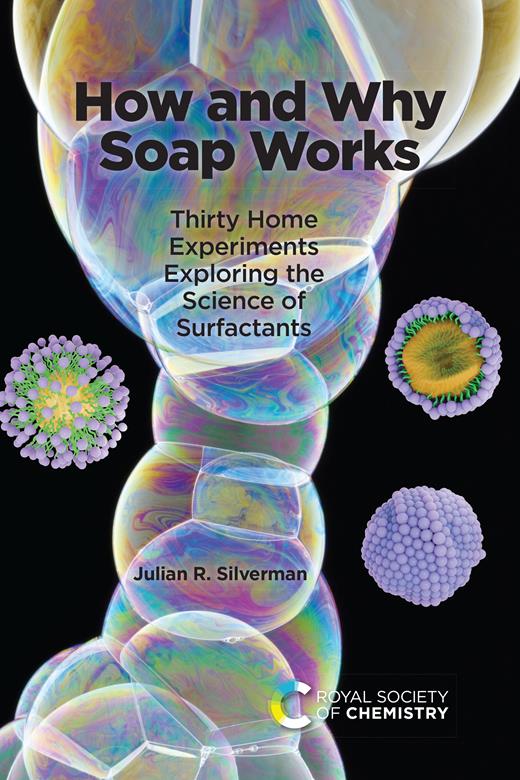
How and Why Soap Works
Thirty Home Experiments Exploring the Science of Surfactants
Soap has been used for centuries worldwide and is key to health and hygiene. But how exactly does soap work? What is in it, and how do the ingredients come together to make something that can remove dirt and bacteria yet also be safe for our skin? How and Why Soap Works explores the science behind this everyday substance. With hands-on demonstrations to try at home you can explore the history of soaps and the science behind how they work, uncover basic concepts across chemistry and materials science, and learn to develop and test your own scientific questions. Along the way, journey through history, medicine, psychology, toxicology, and sustainability to discover that soap is more than just a cleanser. It’s an ancient innovation and an everyday material that shapes how we move through time and space.
How did you first come up with the idea for this work?
During COVID I sat and watched youtube video and demonstrations on Michael Faraday’s The Chemical History of a Candle, though dated, the idea of sequential demonstrations using ever day objects leading us to understand more about the world caught my attention. Shifting to soap, a ubiquitous consumer product, I wanted to create a set of experiments readers could perform at home to explore chemistry and materials science.
What was your research process like?
I spent a lot of time in libraries and archives across the Science History Institute, New York Public Library, and New York Academy of Medicine looking at old soap ads, patent medicine formulas, and exploring the cultural history of soap. My favorite discovery was on 72nd street when a building was being demolished and it revealed a century old advertisement for a washing powder. A lot of the experiments were also texted in classrooms at FIT where students blew bubbles, made emulsions, and crafted soap from cooking oils.
How long did you work on this before it was published?
3 years.
Does this work relate to your role at FIT? If so, how?
Yes, in many ways I wrote this book for my students. Science-curious and interested readers who want to know more about the products they use and put on their bodies. Even though the book wanders into stories that don’t always make it into the classroom, but writing the book I learned so much about how we explain scientific concepts to a general audience.
What was your biggest challenge? What was most rewarding?
The scariest part of the project was starting from an outline and thinking about writing 200+ pages of text, but slow and steady writing, and taking time to read similar texts helped me flesh things out. The most rewarding part was seeing the books reception. From educators, to former mentors, it’s an amazing thing to send a text out into the world and see what others think.
Have you published any other books or have any upcoming publications?
On a related note we just had a paper come out exploring the ‘life cycle of art media’ e.g. paints/pigments/inks. This was a collaboration with the Center for Book Arts (right down 27th street) working with artists and designers on sustainability topics.
- Professor at FIT since 2022
- Book published May 2026