Assistant Professor
Yevgenia Nayberg
- School of Art and Design
- Illustration
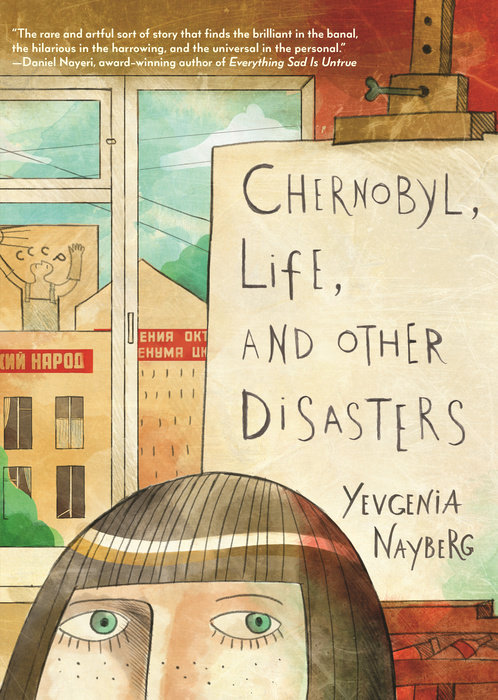
Chernobyl, Life and Other Disasters
Strong-willed Genya sets her mind to attending art school in 1980s Ukraine, amidst the turmoil of Soviet control, the Cold War, and the unfolding Chernobyl nuclear disaster.
Genya knows from age five that she wants to be an artist. When she turns eleven, she’ll apply to the same prestigious art school that her mother attended. But making the cut won’t be easy, especially with the school’s open-secret rule that no more than 1% of the student body can be Jewish.
The years before Genya’s eleventh birthday bring plenty to distract her. Nothing in Soviet Ukraine is quite as it seems; adults mock the government, but only in private; and her classmates are terrified of American bomb strikes. And that’s all before April 26, 1986, when Genya’s police officer neighbor gets called to an emergency in a town she’s never heard of: Chernobyl.
A graphic memoir account of creator Yevgenia Nayberg’s childhood, Chernobyl, Life, and Other Disasters is both deeply personal and a glimpse into broader Soviet intelligentsia experiences. Young readers curious about life elsewhere, particularly in the face of disaster, will find ample details to devour, while those dreaming of a creative life will take inspiration from Genya’s perseverance. Salient and yet often slyly funny, this is a must-read for any graphic memoir fan.
How did you first come up with the idea for this work?
The most vivid memory of my Chernobyl year was the story of my braid. For a long time, I didn’t see this real, nonfictional event as metaphorical—until one day I realized that it was. The moment of cutting my radioactive hair became a symbolic, almost ritual ending of my childhood. Once I crossed that threshold, the book became fiction in its approach, even though all the events in it are real. And fiction is what I prefer to read. It stays with me longer and allows me to interpret it in my own way.
What was your research process like?
Most of my research was visual: I wanted to get the 80s Soviet Union right. I’m eleven years old in the book, and I relied on the memories I had from that time. I did talk to my mother about her memories, and hers were quite different – not because she remembers the same events differently, but because she remembers different things altogether. I left everything as I remembered. In the 1986 Soviet Union, no one knew the full truth about what was happening in Chernobyl. Perhaps we still don’t have the whole picture. I had to replicate an atmosphere of uncertainty, not unlike how we felt in 2020 when the COVID-19 pandemic hit us. But I also had to keep the child’s point of view in mind.
How long did you work on this before it was published?
Close to two years.
Does this work relate to your role at FIT? If so, how?
I teach illustration at FIT and one of my favorite courses is Book Illustration, which included both writing and illustrating. Many of my students are interested in writing and illustrating graphic novels and followed my process while I worked on this book.
What was your biggest challenge? What was most rewarding?
The difficult thing was to forget that I knew the future. It was like using a time machine: I met the people from the past, I know their fate, but I cannot tell them. And because I’m in the past, I cannot act or think like an adult, or else I’d be discovered.
The most rewarding part was to make sure that the book doesn’t have “an accent”, to create a language that flows naturally without sounding exotic.
Is there other information we should know?
My graphic memoir comes out on the 40th anniversary of Chernobyl Disaster.
Have you published any other books or have any upcoming publications?
I have published 15 picture books (half of which I wrote and illustrated). I have two more picture books on the way: The first one, Another Tongue, is out in July 2026. It’s my take on what it feels like to learn a second language when moving to a new country. The second one, Not So Super Hero, was inspired by my public art project — a New York Superhero poster for the MTA. It’s the story of a reluctant superhero who goes on an adventure to please his immigrant parents. It will be published in 2027.
- Professor at FIT since 2022
- Book published in April 2026